Open your phone’s voice memo app right now. Odds are there’s a list of recordings sitting in there called something like “New Recording 47”, each one somewhere between eight seconds and eleven minutes long, and you have no idea what’s inside any of them.
You recorded them for a reason. At the time, each one felt worth keeping. But you’ve never gone back to a single one, because opening them costs more effort than the idea inside feels like it’s worth.
This is the quiet failure mode of voice notes, and it has nothing to do with recording. Capturing an idea by speaking is already the fastest option available. The problem starts the moment you stop recording.
The Real Problem: Retrieval, Not Capture
A note has two jobs. It has to catch the thought, and it has to give it back to you later. Voice memos are excellent at the first job and terrible at the second.
Think about what it actually takes to retrieve one idea from an audio file:
- You can’t skim it. Audio plays at one speed, in one direction.
- You can’t search it. A file name and a timestamp tell you nothing about the content.
- You often can’t even play it. Not on a quiet train, not in an open-plan office, not without headphones you forgot at home.
- You have to guess. Finding one sentence in a seven-minute recording means scrubbing back and forth until you get lucky.
Written notes have none of these problems, which is why so many people give up on voice notes and go back to typing, even though typing is slower. It isn’t that speaking failed. It’s that the recording never became something you could use.
Why “I’ll Sort It Out Later” Never Happens
The usual advice is to review your recordings at the end of the day and write up the good ones. It sounds reasonable. Almost nobody does it.
The reason is simple: reviewing is a separate task, and it’s a boring one. You already had the idea. Listening back to yourself half-mumbling it in the car feels like homework, and any system that depends on a daily chore you don’t enjoy will collapse within a week or two.
A note-taking system only survives if the organising happens automatically, without you scheduling time for it.
A Simple System That Actually Sticks
You don’t need a complicated setup. Four habits cover almost everything.
1. Say the topic in the first five seconds
Start every recording by naming what it’s about before you start explaining it. “Pricing idea for the new plan.” “Follow-up from the call with the supplier.” Those first few words become the title, the search term, and the thing that tells you whether to open the note at all.
2. Keep one idea per note
Two short recordings beat one long one every time. A note holding a single thought can be found, acted on, and then finished with. A twelve-minute stream of consciousness containing four unrelated ideas can only be re-listened to, which means it won’t be.
3. Say the next action out loud
End with what you’d want to do about it: “email her Tuesday”, “check the numbers”, “worth a blog post”. Future you isn’t looking for the idea so much as for what to do with it. Saying it while the thought is fresh takes three seconds and saves the whole note from becoming trivia.
4. Make it text, immediately
This is the one that makes the other three pay off. Once a recording becomes text, it stops being an audio file you have to commit time to and becomes a note you can glance at. You can scan it in two seconds, search a word you half remember, paste a line into an email, or read it in a meeting without headphones.
The transcript doesn’t have to be perfect, either. It only has to be good enough that searching a keyword surfaces the right note. That’s a much lower bar than “flawless dictation”, and it’s enough to change how often you go back to your notes.
Speak Fast, Read Later
The goal isn’t to record more. Most people already record plenty. The goal is to make sure that a thought you had on a walk three weeks ago is still available to you today, in a form you can find in a few seconds.
Speak to capture, because it’s the fastest way to get an idea out of your head. Read to retrieve, because text is the only format you can scan and search. As we covered in our look at voice notes versus written notes, this was an either-or choice for a long time. It isn’t anymore, as long as the conversion from one to the other happens without you having to do it by hand.
Fix the retrieval half of the problem and your voice notes stop being an archive you avoid. They become something you actually use.
Try it for yourself
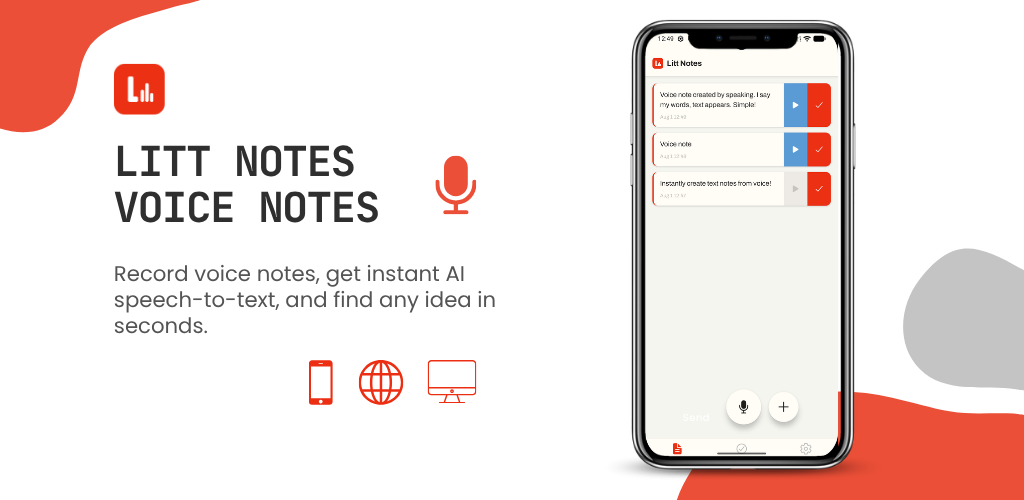
Litt Notes records your voice and transcribes it to searchable text on your device, so every note you speak is one you can find again later. It’s launching soon.
Leave a Reply