There’s a difference between keeping something and being able to find it. Most people who record voice notes have solved the first problem completely. Their recordings are all there, safely stored, sorted by date. And that’s the trouble: date is the only thing they can sort by.
A folder of recordings is storage. A folder of searchable transcripts is something closer to a memory you can ask questions of. The gap between the two is bigger than it sounds.
Browsing Is Not Searching
When you go looking for an old note, you almost never remember when you recorded it. You remember a fragment of what was in it — a name, a number, a phrase you used. “That thing about the pricing tiers.” “The supplier whose name began with a V.”
A recordings folder can’t help you with any of that. It offers you a list ordered by something you’ve forgotten, and asks you to open files one at a time until you get lucky. So you do the arithmetic — three minutes of scrubbing versus just thinking the thought again from scratch — and you close the app.
Search inverts that. You type the fragment you do remember and the right note surfaces. The thing you half-remembered is exactly the thing that finds it.
What You Actually Get When Notes Become Searchable
Transcription is usually sold as convenience — text instead of audio, nice to have. But the useful part isn’t the reading. It’s everything search makes possible once the words exist:
- Partial recall is enough. One remembered word out of a five-minute recording is a working search query. You no longer need to remember which note, only something that was in it.
- Old notes stay alive. In an audio folder, a note’s usefulness decays with every new recording pushed on top of it. A searchable note from eight months ago is as reachable as one from this morning.
- You find patterns, not just notes. Search a client’s name and you get every time you’ve mentioned them, in order. That’s a history you never sat down to write.
- Results are skimmable. Four text matches can be scanned in seconds to see which one you meant. Four audio files can only be played, one after another.
- The content becomes reusable. Once a note is text you can quote a line in an email, drop it into a document, or paste it into a task — without transcribing it by ear.
None of these require the transcript to be perfect. They only require it to contain the words you’ll later think of.
Why Renaming Your Files Isn’t the Answer
The obvious workaround is to label recordings as you make them. Give each one a descriptive title, maybe a folder, and you’ve made your archive navigable.
It works, briefly. Then it fails for two reasons.
The first is friction. You record voice notes precisely because you’re walking, driving, or between two other things. Stopping to type a title defeats the point of speaking in the first place, so eventually you skip it — and one skipped note in ten is enough to make you stop trusting the system.
The second is that a title is a summary written by the wrong person. You label a note at the moment of recording, when you know what matters about it. You search for it months later, when you don’t. The word you’ll eventually look for is usually buried in the middle of what you said, not in the title you chose. Full text catches it. A label doesn’t.
Searchable Doesn’t Have to Mean Uploaded
One reasonable hesitation about transcribing everything: voice notes are candid. They contain half-formed opinions, client details, personal admin, things said out loud precisely because nobody was going to hear them.
That’s a real consideration, and it’s worth knowing where transcription happens. Speech-to-text that runs on the device keeps the recording and its text on the device. You get the search without your unfiltered thinking going anywhere else — which matters more for a note archive than for almost anything else on your phone, because the archive is honest in a way your documents aren’t.
From Archive to Something You Use
A note only earns its keep the second time you meet it. Everything before that — the recording, the storing, the syncing — is setup. If retrieval never happens, the whole thing was a filing exercise.
This is the same problem behind why you never listen to your voice notes again, and the reason people keep choosing typing over speaking even though speaking is faster, as we covered in voice notes versus written notes. Capture was never the weak link. Search was.
Make your recordings searchable and you stop keeping an archive you avoid. You start keeping notes you can ask questions of.
Try it for yourself
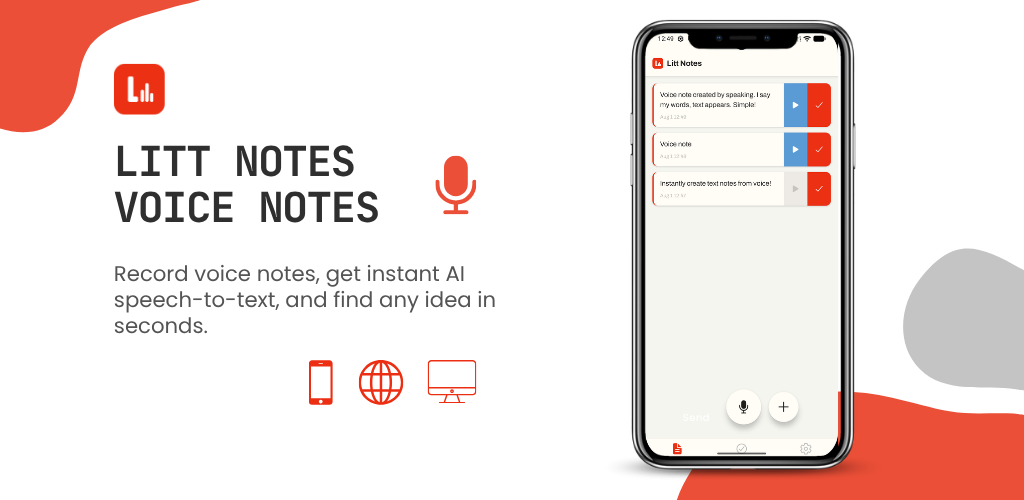
Litt Notes records your voice and transcribes it to searchable text on your device, so any idea you’ve spoken is one keyword away. It’s launching soon.
Leave a Reply